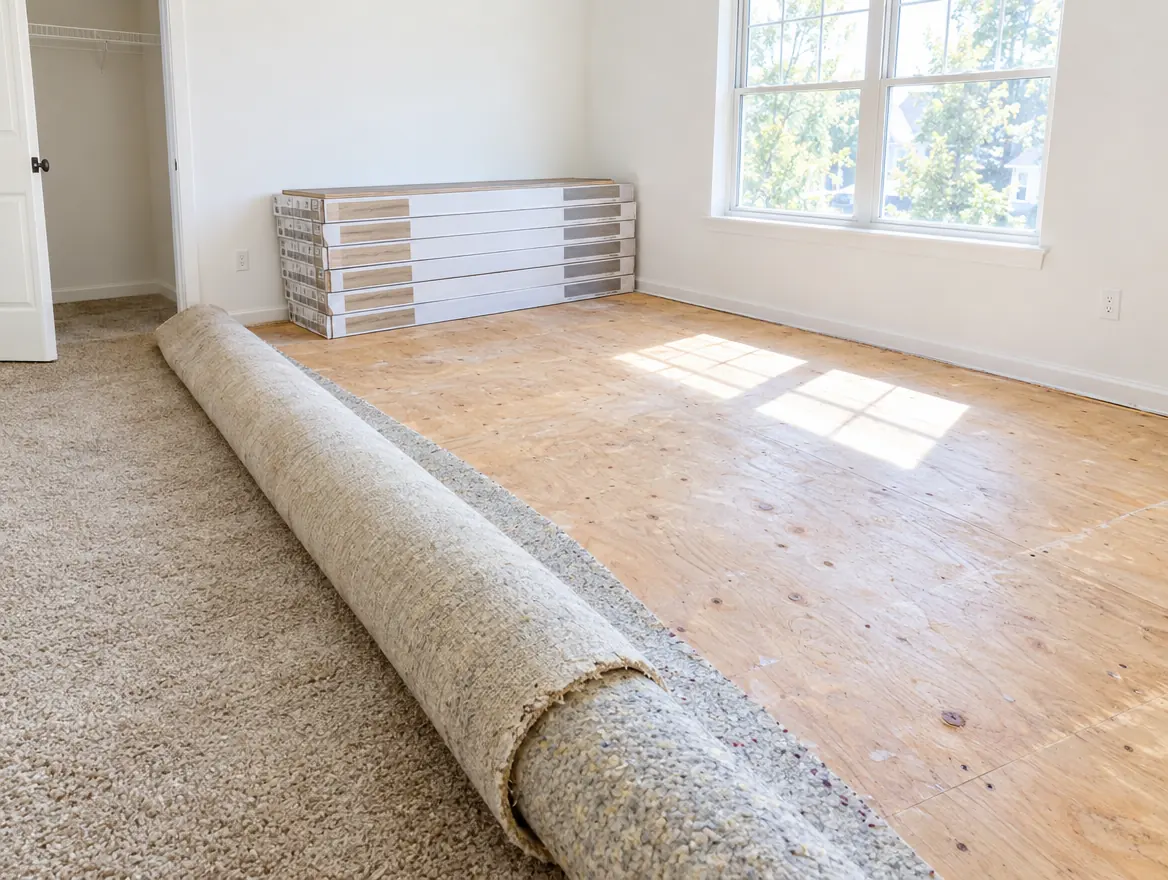
Why people pull the carpet
Carpet usually gets replaced for the same few reasons. There’s a path worn from the door to the couch. A dog or an older cat has had accidents that soaked through to the pad, and the smell comes back every humid day. Or someone in the house has allergies and the carpet never feels clean no matter how often it’s vacuumed.
That last one has a basis. The EPA’s asthma guidance lists carpet among the places dust mites live and suggests keeping pets off carpets for people with asthma. A hard floor gives dust nowhere to settle in, and a damp mop picks up what a vacuum leaves behind.
Vinyl plank also fixes the pad problem for good. Because the SPC core is waterproof, a spilled drink or a pet accident stays on the surface where you can wipe it up instead of wicking down into foam.
There’s a practical side for people planning to stay in their house for the long haul. Thick carpet grabs at walker feet and slipper soles, and the edges of worn carpet curl into a trip hazard at doorways. A flat plank floor with a textured finish rolls easily under a walker or wheelchair and gives shoes steady footing.
What’s under your carpet
Until the carpet comes up, nobody knows for certain what’s underneath. In most houses it’s one of these:
- Plywood or OSB subfloor. The most common. It gets checked for soft spots, squeaks and stains from old leaks.
- Old wood plank subfloor. Boards laid diagonally or straight across the joists, often in older homes. It can be uneven at the seams and may need patching or a layer of plywood.
- Hardwood. Sometimes original oak turns up under wall-to-wall. If it’s in good shape, refinishing it may make more sense than covering it, and we’ll say so. If it’s damaged, patched or cupped, plank can go over it once it’s flat and tight.
- Old tile or sheet vinyl. Common in basements and in rooms that were remodeled more than once. Older 9 by 9 inch tile can contain asbestos, so it gets tested, never sanded, and usually covered where it lies.
- Concrete. In basements and slab homes. That job is closer to our basement flooring page, with a moisture check first.
Tear-out and subfloor prep
Plank makers require carpet and pad to come out completely before their product goes down. That means the carpet, the foam pad, the tack strip nailed around the edge of the room, and every staple that held the pad. A staple left behind shows up later as a small bump under a plank.
With the subfloor bare, this is the best chance in decades to fix squeaks. A squeak usually means a subfloor panel has worked loose from a joist, and a few screws stop it. Once plank is down, that spot is out of reach.
Then the installer checks flatness. A common maker limit is no more than 3/16 of an inch of dip over 10 feet. Carpet hides a lot, so a floor that felt fine underfoot can show ridges at panel seams or a dip near an old heat register. High spots get sanded and low spots get patched until the floor is flat enough for the planks to lock without flexing.
Floor registers get the same care. The grille comes out, the plank is cut to the edge of the duct opening, and the grille drops back in flush with the new surface. If a register sat tight against a wall under the carpet, the installer marks it at the measurement so the cut is planned ahead of time.
Doors, baseboards and where rooms meet
Carpet and pad together are usually thicker than a vinyl plank. Doors that dragged on the carpet generally clear the new floor with room to spare, and closet doors often start closing properly again.
Baseboard takes a little thought. Carpet installers often tuck the edge of the carpet under the base, so once it’s gone there can be a small gap along the bottom of the trim. The plank needs its own gap at the wall anyway, so a thin base shoe or quarter round covers both. If your baseboard is already loose or damaged, replacing it is an option, and the installer will price it both ways.
Where a new plank floor meets a room that keeps its carpet, a transition strip ramps from one height to the other. Doing a whole level at once avoids most of those strips, which is easier on anyone who shuffles, uses a walker or carries a laundry basket.
Keeping an upstairs floor quiet
The one thing carpet does well is soak up sound. Replacing it on a second floor can make footsteps more noticeable in the rooms below, and a floating floor over an uneven subfloor can sound hollow in spots.
- Plank with an attached pad deadens footsteps better than bare plank.
- A flat subfloor matters for noise as much as for looks. Gaps under a plank are what make it click and drum.
- Area rugs in bedrooms and under the couch put back some of the softness where you want it.
Our comparison of luxury vinyl plank installation options explains wear layers and cores if you’re still choosing a product. For a house with dogs, a 20-mil wear layer is the one to pick.
The carpeted staircase
Stairs are usually the most worn carpet in the house, and they’re the hardest part to match once the rooms around them change. Each tread and riser gets its own piece of plank with a matching stair nose, fitted one step at a time. It’s a separate job with its own pricing, covered on our vinyl plank stairs page. Many families do the rooms first and the stairs later, or both at once to finish the look.
What replacing carpet costs
As an estimate, replacing carpet with vinyl plank runs $5 to $12 per square foot installed, before your discount. A 200 square foot room is roughly $1,200 to $1,900 before the discount. Three bedrooms and a hall at about 550 square feet come to roughly $3,300 to $5,225 before the discount. What moves a carpet job within that range:
- Carpet with glued-down pad, which takes longer to scrape up
- Screwing down squeaks and patching an uneven or old plank subfloor
- New base shoe or baseboard around every room
- Closets, doorways and transitions to rooms that keep carpet
If you’re getting a parent’s house ready to list, our guide on whether new floors are worth it before selling walks through that decision. The calculator below works out a ballpark from your square footage, and after the free measurement you get a written price for your rooms before any plank is ordered.
Pulling carpet often means pulling baseboards or quarter-round too. In a home built before 1978, that painted trim counts toward the EPA’s 6-square-foot-per-room line, and past it paid work has to follow lead-safe rules unless the paint tests lead-free (40 CFR Part 745, Subpart E). In Pennsylvania the job also needs a written contract with the installer’s registration number (73 P.S. §517.7). More in our guide to Pennsylvania flooring contracts.
Sources: Karndean rigid core installation guide (carpet removal, flatness) · EPA asthma triggers: dust mites and pets · EPA asbestos guidance · manufacturer installation guides for the plank you choose.