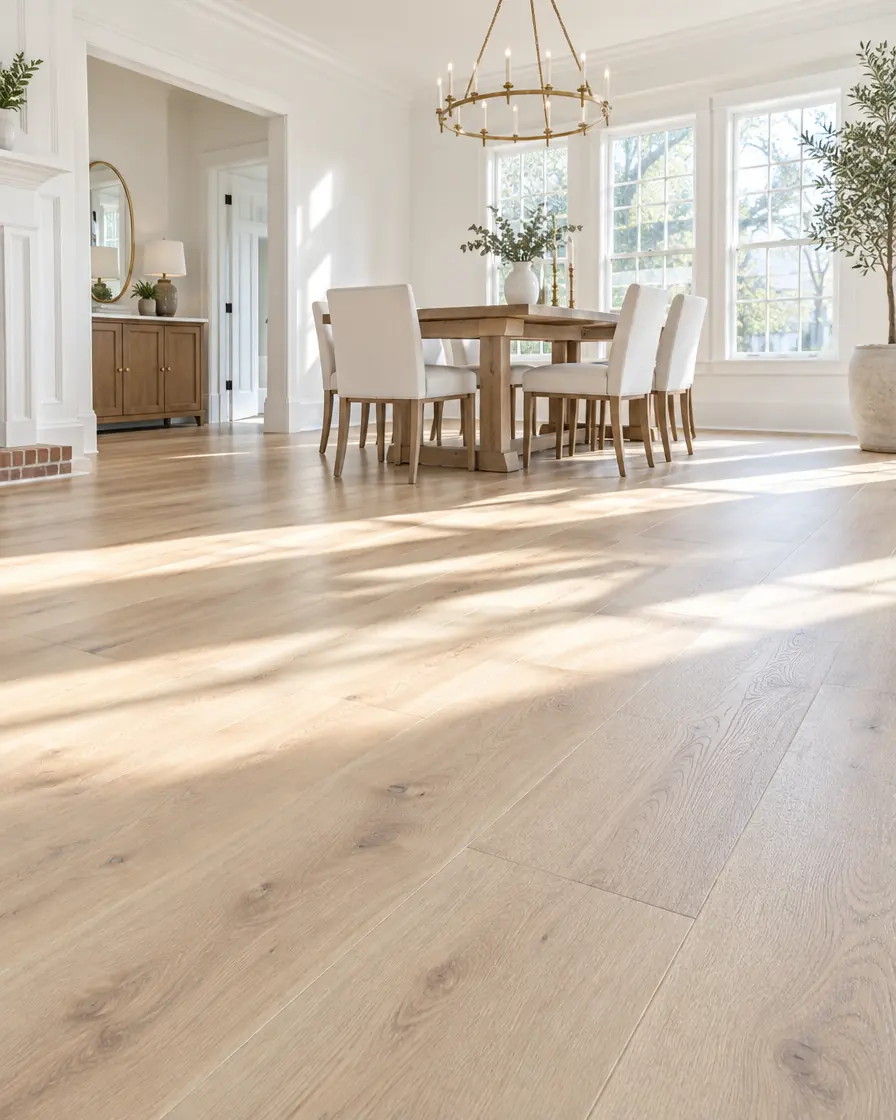
What luxury vinyl plank actually is
Luxury vinyl plank, usually shortened to LVP, is a click-together floor made in layers. On top is a clear wear layer that takes the scuffs. Under it is a printed film that gives the plank its wood look. Below that is the core, and on most of what we install there’s a thin pad bonded to the bottom.
The core is what matters most. We install SPC, which stands for stone plastic composite: limestone powder and PVC pressed into a rigid board. There’s no wood fiber in it, so there’s nothing in the plank that can soak up water and swell. That rigid core is also why SPC bridges small bumps in a subfloor better than older, floppy sheet vinyl ever did.
Waterproof flooring installation: what it covers
People searching for waterproof flooring installation usually have a specific worry in mind: a dog’s water bowl, a kitchen sink that drips, a toddler in the bath, or a basement that gets damp every spring. SPC plank handles all of those. Water sitting on the surface or rising from a slab won’t make the plank warp, bubble or come apart.
Here is where the word stops. Waterproof describes the plank. It doesn’t make a room safe from a flood. If water stands on a floor for days, the subfloor, the drywall and the framing still get wet, and those need to dry. FEMA keeps its own list of flood-damage-resistant building materials for flood zones, and we don’t claim our plank belongs on it. What we promise is plainer: spills, leaks and a damp slab won’t ruin the floor.
- Handles well: pet accidents, tracked-in snow, a leaking dishwasher found the same day, bath splashes, moisture coming up through concrete within the maker’s limits.
- Needs more than a floor: a sump pump that can’t keep up, a foundation that lets water in during every storm, a river or creek that reaches the house.
If your basement has already taken on water, start with the flooded basement floor replacement page, which covers what has to happen before any new floor goes down.
Picking a wear layer
The wear layer is measured in mils, and one mil is a thousandth of an inch. We carry three thicknesses, and the right one depends on who walks on the floor and how hard.
- 6 mil: a guest room, a closet, an office with little foot traffic.
- 12 mil: most bedrooms and living rooms in a house without big dogs.
- 20 mil: kitchens, hallways, entries, and any house with kids or pets. 20-mil SPC can last 20+ years.
The difference in price between 12 and 20 mil is usually small next to the cost of redoing a floor early. Our guide on wear layers and which one pets need goes further, and how long vinyl plank lasts covers what wears a floor out besides traffic, such as grit, sun and furniture legs.
SPC next to the alternatives
Most homeowners we measure for are choosing between three floors that look almost the same in the store. The differences show up after a few years.
| Floor | Water on the surface | Dents and dog nails | Feel |
|---|---|---|---|
| Laminate | Resists it briefly; edges can swell | Hard top layer | Firm, can sound hollow |
| WPC vinyl | Waterproof | Softer core dents more | Cushioned, quiet |
| SPC vinyl plank | Waterproof | Rigid core resists dents | Firm, quieter with attached pad |
WPC (wood plastic composite) has a foamed core that feels softer and can dent under a piano leg or a dropped cast-iron pan. Laminate has a fiberboard core, which is why a slow leak shows up as swollen seams. The full breakdown is in SPC, WPC and laminate, explained plainly.
How the install goes in an older house
Many older homes in Western Pennsylvania and Northern West Virginia have floors that have settled, rooms that were added on at different heights, and plaster walls that aren’t quite straight. None of that stops a vinyl plank floor. It just decides how much prep comes first.
Plank makers set a flatness limit in their installation guides. A common one is no more than 3/16 of an inch of dip over 10 feet. Flat is different from level: a floor can slope gently toward one corner and still be fine, as long as it doesn’t have humps and hollows. High spots get sanded or ground down, and low spots get filled with patch.
Temperature matters too. Makers commonly require the room to sit between about 65 and 85°F before, during and after the install. In January that means the heat has to be on in a room that’s been closed off, and a sunroom or a camp may need a different product or a wider gap at the walls.
Old trim gets its own decision. Original baseboard in an older home is often thick, painted many times, and nailed into plaster that cracks if it’s pried hard. Where the base is worth keeping, it stays on the wall and a thin base shoe covers the gap at the floor. Door casings get undercut with a flush saw so the plank slides under them, which looks cleaner than cutting the plank around each profile.
Most of what we install floats. The planks lock to each other, the floor rests on the subfloor without glue or nails, and a gap is left at every wall so it can move with the seasons. Glue-down plank is the better choice in a few spots, like very large open areas or rooms with heavy rolling loads. Our guide to glue-down or floating vinyl plank explains when each one fits.
Where it goes in the house
Because it tolerates water, SPC plank can run through nearly every room on a floor without a change in material. That means fewer thresholds to trip on, which matters for anyone planning to stay in the house as they get older.
- Basements, once the slab passes a moisture check.
- Bedrooms and living rooms, usually replacing old carpet.
- Kitchens and bathrooms, where splashes are daily.
- Mudrooms and entries that see snow, slush and road salt.
- Stairs, with a matching nose on every tread.
- Rooms with old ceramic, where tile removal and replacement comes first.
What vinyl plank installation costs
As an estimate, luxury vinyl plank installation runs $5 to $12 per square foot installed, before your discount. A 200 square foot room is roughly $1,200 to $1,900 before the discount. A 1,000 square foot main floor is roughly $6,000 to $9,500 before the discount. The things that move a job within that range:
- The wear layer and plank you pick
- What comes up first: carpet, tile, or an old floating floor
- How much patching or grinding the subfloor needs
- Stairs, closets, and a lot of doorways and transitions
The current offer is 50% off your flooring installation, plus $1,200 Off + 5% Senior & Military Savings. Financing includes low monthly payments, 0% interest plans, and same-as-cash offers (for qualified applicants). For a line-by-line look at pricing, read what vinyl plank costs installed, or use the calculator below for a ballpark. Your exact price comes from the free measurement and is written down before a single box is ordered.
In Pennsylvania, a vinyl plank job over $500 is a home improvement, so the contract has to be written and carry the installer’s PA registration number, the total price, the materials and the approximate start and finish dates (HICPA §7, 73 P.S. §517.7(a)). In both states, a sale of $25 or more made at your home comes with the federal three-business-day right to cancel (16 CFR Part 429). The full checklist is in our guide to Pennsylvania flooring contracts.
Sources: Karndean rigid core installation guide (flatness, temperature, expansion gaps) · FEMA Technical Bulletin 2: flood damage-resistant materials · manufacturer installation guides for the plank you choose.