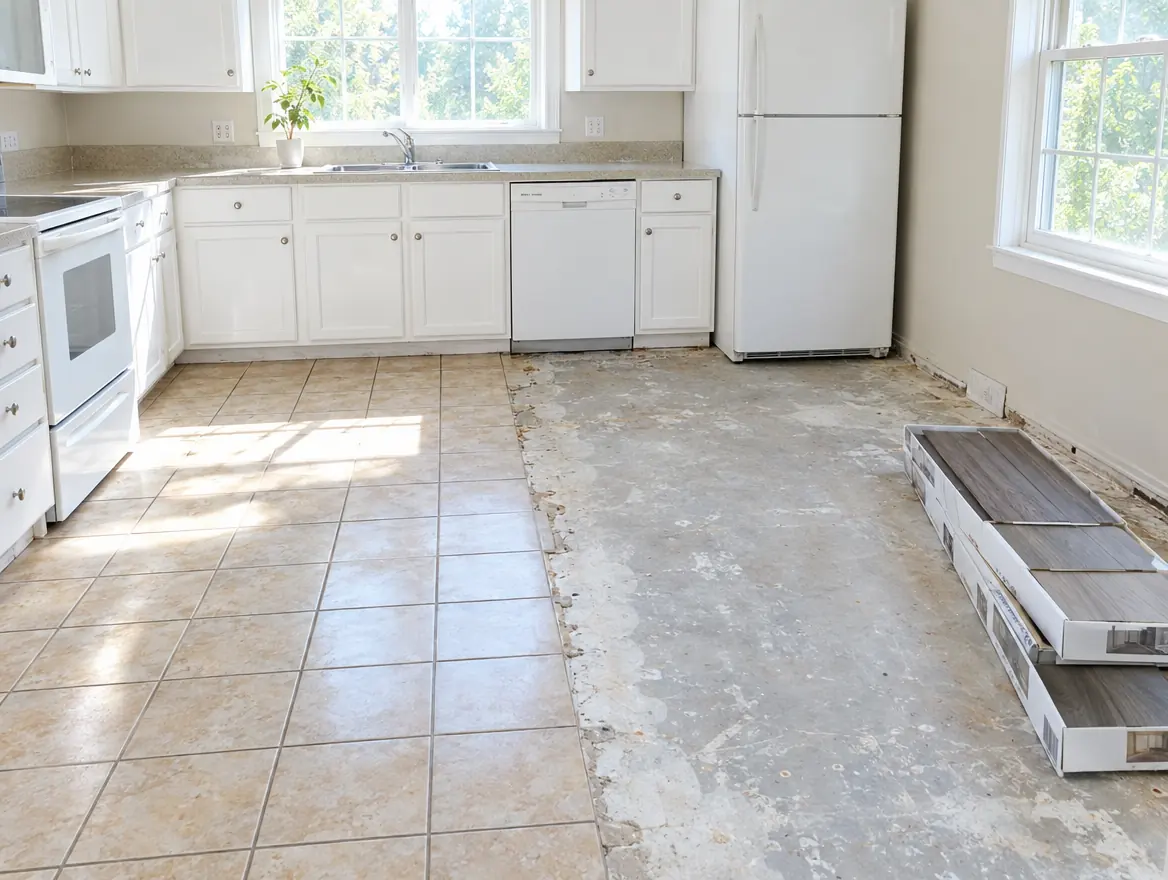
Two kinds of old tile
When people say “tile,” they usually mean one of two very different floors, and the plan for each one is different.
- Ceramic or porcelain tile. Hard, fired clay set in mortar with grout between the pieces. Common in kitchens, bathrooms, entries and some basements. It’s heavy, it’s cold, and when it cracks or the grout goes, it looks tired fast.
- Resilient tile. Thin, flexible squares glued to the floor, often 9 by 9 or 12 by 12 inches. You’ll find it in basements, kitchens and back halls of many older homes, sometimes under a layer of carpet or newer vinyl. Older 9 by 9 inch tile and the black glue under it can contain asbestos.
The first question at the measurement is which kind you have. The second is whether it needs to come up at all.
Remove it or float over it
Tearing out old tile is the part of this job homeowners expect, and sometimes it’s the right call. Often it isn’t necessary. Rigid-core (SPC) vinyl plank can float over a hard floor that is solid, well bonded and flat enough for the maker’s spec. Makers commonly ask for no more than 3/16 inch of variation over 10 feet, or 1/8 inch over 6 feet.
Covering tile makes sense when:
- The tile is firmly stuck down, with no hollow-sounding or loose pieces
- The floor is flat, or the grout lines and low spots can be filled with a patch
- The extra height works at doors, the dishwasher and where the floor meets the next room
- The tile may contain asbestos, and leaving it undisturbed is the safer choice
Taking it out makes sense when tiles are cracked and loose, when the floor is badly out of flat, when a thick old mortar bed makes the floor sit too high, or when the extra height would leave a step at a doorway. The installer checks each of these at the measurement and tells you which way the job should go and why.
Old 9×9 tile and black mastic
This is the most important part of a tile job in an older house. Resilient floor tile and the black, tar-like adhesive under it (often called cutback or mastic) were made with asbestos for many years. You can’t tell by looking. The only way to know is to have a sample tested by an accredited lab.
The EPA’s advice for homeowners is clear. Leave undamaged asbestos-containing material alone. Don’t sand, scrape, saw or drill it. Don’t sand or try to level asbestos flooring or its backing, and when it needs replacing, install new flooring over it if possible. The flooring industry’s own removal guidance says the same thing: don’t sand, dry scrape, grind or bead-blast old resilient flooring or its adhesive, and if you’re not sure it’s asbestos-free, treat it as if it contains asbestos.
Here’s what that means for your job:
- We don’t do asbestos testing or abatement. If your tile is old enough to be a question, have it tested by a licensed inspector before any work is planned.
- Covering it is often the simplest answer. If the tile is intact and well bonded, a floating plank floor can go right over it, and the old tile stays sealed underneath.
- If it has to come out, that’s a job for a licensed abatement contractor. Once it’s gone and cleared, we install the new floor.
- Nobody grinds or sands it. That includes flattening a high spot. Low spots get patched on top instead.
Our guide on old 9×9 floor tiles goes through the test, the choices and what to ask.
Taking up ceramic tile
When ceramic tile does come up, it’s loud, dusty and heavy work. The tile is broken free, the thin-set mortar under it is knocked down, and the debris is hauled out in buckets. On a concrete slab the result is usually a rough but sound surface that gets patched flat.
On a wood subfloor there’s more to look at. Older bathrooms were sometimes tiled over a thick mortar bed, which can be an inch or more deep. Newer tile often sits on cement board screwed to the plywood. Either one may come up, and the subfloor underneath is checked for soft spots, old leak damage around the toilet or tub, and nails that have worked loose.
Before anything is broken, the room gets prepped. Doorways are closed off, vents are covered, and furniture and appliances come out. If there’s any chance the tile or its setting bed was laid over older resilient flooring, that layer is treated with the same asbestos caution before removal starts.
What’s under the tile, and what it needs
Tile hides a lot. Once it’s up, or once the installer has sounded it out, the floor underneath usually needs one of these:
- Patching. Grout lines, chips and low spots filled with a cement patch so the plank sits flat.
- Leveling a dip. Many older homes have floors that sag toward the middle of a room. The goal is flat, which is different from perfectly level.
- Subfloor repair. Soft wood near a toilet or tub gets cut out and replaced with plywood before the new floor goes down.
- A new underlayment panel. Sometimes a thin sheet of plywood over an old plank subfloor is the fastest way to a flat surface.
For more on sagging and out-of-level rooms, see flat vs level: uneven floors in older homes. If the tile only covers part of the house and the rest is old hardwood, putting vinyl plank over old hardwood explains when that floor can stay underneath.
Kitchens, baths, entries and basements
Most tile floors are in rooms that see water, which is exactly why a waterproof plank is the usual replacement. SPC plank doesn’t swell when a dishwasher leaks or a bath mat stays wet. It covers spills, leaks and a damp slab. Standing floodwater is a different matter.
In kitchens and bathrooms the new floor has to work around cabinets, the toilet and the tub, and our kitchen and bathroom vinyl flooring page covers those details. At back doors and mudrooms, winter salt and slush add their own demands; see mudroom and entryway flooring. In basements, old tile often sits on a slab that also needs a moisture check, which our basement flooring page explains.
Plank also changes how the room feels. It’s warmer and softer underfoot than ceramic, there’s no grout to scrub or reseal, and a dropped glass is less likely to shatter.
What tile removal and replacement costs
The new floor runs $5 to $12 per square foot installed, before your discount, as an estimate. A 200 square foot room is roughly $1,200 to $1,900 before the discount. Tile adds prep on top of that, and how much depends on which way the job goes:
- Floating over sound tile usually adds the least, often just patching the grout lines
- Removing ceramic tile adds demolition, debris hauling and patching
- A thick mortar bed or soft subfloor adds repair work
- Asbestos testing or abatement, if needed, is done by a licensed specialist and billed separately by them
Put your room size into the cost calculator for a starting range. After the free measurement you get a written price with removal and prep spelled out, and nothing is ordered until you agree to it.
The federal asbestos notification rules for renovation apply to ‘facilities’, and that definition leaves out houses with four or fewer units (40 CFR §61.141). Condo buildings aren’t excluded, and none of this makes old 9×9 tile or black mastic safe to tear up: have it tested before anyone disturbs it. In Pennsylvania, whatever is being removed belongs in the written contract’s description of the work (73 P.S. §517.7(a)). More in our guide to Pennsylvania flooring contracts.
Sources: EPA: protect your family from exposures to asbestos · Resilient Floor Covering Institute: recommended work practices for removal of resilient floor coverings · Evoke luxury vinyl installation guide (flatness, existing floors) · manufacturer installation guides for flatness limits.